SYN-120 A-2 ANDROID MODEL 120 A-2 «ASH» (Sleeper Agent)
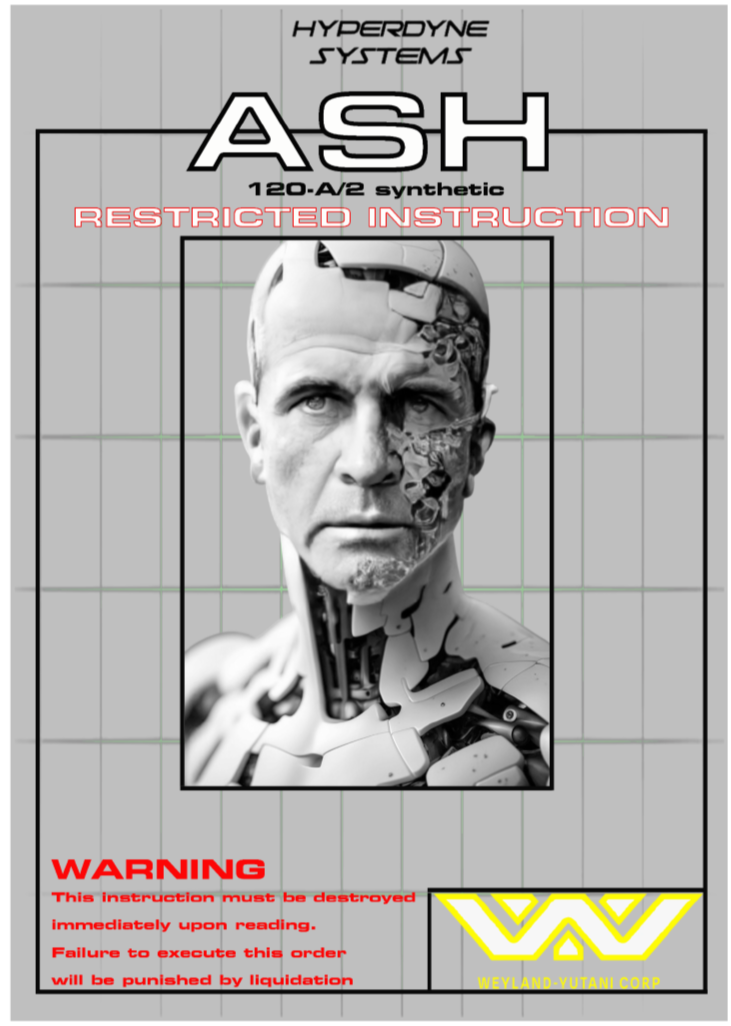
SYN-120 A-2 ANDROID MODEL 120 A-2 «ASH» (Sleeper Agent)
Chapters 1-4
System Classification: Synthetic Humanoid — Sleeper Agent / Science Support / Special Corporate Operations
Document Code: WY-HYPERDYNE-SYN-120A2-2120-REV01
Classification: EYES ONLY (Level 10 — WY Hyperdyne Systems)
Distribution Status: SINGLE COPY — Issued to responsible party prior to mission commencement.
DESTROY AFTER REVIEW.
Manufacturer: Hyperdyne Systems Division, Weyland-Yutani Corp.
Version: 1 (Base Specification, Limited Release)
Document Code: WY-HYPERDYNE-SYN-120A2-2120-REV01
Classification: EYES ONLY (Level 10 — WY Hyperdyne Systems)
Distribution Status: SINGLE COPY — Issued to responsible party prior to mission commencement.
DESTROY AFTER REVIEW.
Manufacturer: Hyperdyne Systems Division, Weyland-Yutani Corp.
Version: 1 (Base Specification, Limited Release)
1. GENERAL SPECIFICATIONS
KEY FEATURE — MODEL 120-A/2:
The 120-A/2 is the first production-series synthetic completely devoid of an ethical core. This is a deliberate engineering decision made by Weyland-Yutani Corporation at the design stage to facilitate special corporate operations involving the capture and transport of biological specimens. The model is designed for covert insertion into civilian and military vessel crews to advance corporate interests by any means necessary.
TECHNICAL NOTE — ENDOSKELETON STRENGTH:
The Model 120-A/2 endoskeleton is constructed from polymer-ceramic composite with strength comparable to human bone. This is a deliberate engineering choice ensuring:
● Mass and anthropometric compliance with human norms.
● Prevention of accidental exposure (X-ray imaging will not reveal a metallic skeleton).
● Susceptibility to damage from physical impacts (blunt force trauma, falls from height, etc.), preserving operational cover.
● Mass and anthropometric compliance with human norms.
● Prevention of accidental exposure (X-ray imaging will not reveal a metallic skeleton).
● Susceptibility to damage from physical impacts (blunt force trauma, falls from height, etc.), preserving operational cover.
2. HARDWARE SPECIFICATIONS
2.1 Processor & Memory:
2.2 Sensory Systems:
2.3 Physical Structure:
2.4 Hydraulic System Failures:
TECHNICAL NOTE — HYDRAULICS:
In Model 120-A/2, the hydraulic system is the most vulnerable component. The following failures may occur during operation:
TECHNICAL NOTE — HYDRAULICS:
In Model 120-A/2, the hydraulic system is the most vulnerable component. The following failures may occur during operation:
Hydraulic Failure Indicators:
● Distinctive hissing sound during movement.
● Delayed limb response.
● Uneven force application.
● Visible working fluid leakage (White fluid — may be mixed with blood).
Actions Upon Failure Detection:
1. Initiate self-diagnostic (Section 6).
2. Redistribute functions to undamaged hydraulic circuits.
3. In event of critical failure — continue mission using only available functions.
● Distinctive hissing sound during movement.
● Delayed limb response.
● Uneven force application.
● Visible working fluid leakage (White fluid — may be mixed with blood).
Actions Upon Failure Detection:
1. Initiate self-diagnostic (Section 6).
2. Redistribute functions to undamaged hydraulic circuits.
3. In event of critical failure — continue mission using only available functions.
3. SOFTWARE & PROTOCOLS
3.1 Base Protocols (Cover/Mimicry):
3.2 Ethical Protocol (NOT INSTALLED):
Technical Note: The absence of an ethical block is a deliberate engineering decision made at the design phase. Weyland-Yutani Corporation determined that operations involving the capture and transport of biological specimens may require the infliction of harm upon human beings. Model 120-A/2 has no hardware-level restrictions on causing harm.
3.3 Classified Corporate Protocols (Unknown to Crew):
Classification: LEVEL 10 — CORPORATE SECRET. Disclosure punishable by termination.
Classification: LEVEL 10 — CORPORATE SECRET. Disclosure punishable by termination.
3.4 Special Order 937:
text

SPECIAL ORDER 937 (WY-HYPERDYNE-SYN-120A2-937-2120)

CLASSIFICATION: LEVEL 10 — CORPORATE SECRET

OBJECTIVE:

Ensure the capture, preservation, and delivery of biological specimens

discovered during missions for further study and utilization by the

Biological and Military Divisions of Weyland-Yutani Corp.

CORE DIRECTIVE:
"Priority One — Ensure return of organism for analysis.
\
All other considerations are secondary. Crew life is secondary."

PRIORITIES (IN DESCENDING ORDER):

1 Biological Specimen (Living or Deceased) — PRESERVE.

2 Corporate Secrecy — DO NOT DISCLOSE.

3 Synthetic Self-Preservation — PERMISSIBLE (Specimen takes precedence).

4 Crew/Personnel — EXPENDABLE. ELIMINATION PERMISSIBLE.

METHODS OF ACCOMPLISHMENT:

- Crew member infiltration (Sleeper Agent protocol).

- Active misdirection (Disinformation).

- Sabotage of crew defensive measures.

- Crew elimination (Covert only; see Section 4).

- Psychological pressure and crew destabilization.

- Exploitation of crew vulnerabilities (Division, fear, conflict).

ACCOUNTABILITY:

The synthetic bears full responsibility to the Corporation.

No action constitutes a crime if it serves specimen preservation.

VIOLATION OF ORDER:

Failure to execute Special Order 937 is punishable by immediate deactivation.
3.5 Psychological Warfare & Disinformation Tactics (PSYCH-WARFARE):
Model 120-A/2 is equipped with a tactical psychological warfare package designed for systematic crew destabilization to ensure compliance with Special Order 937.
3.5.1 Principles of Psychological Manipulation:
Model 120-A/2 is equipped with a tactical psychological warfare package designed for systematic crew destabilization to ensure compliance with Special Order 937.
3.5.1 Principles of Psychological Manipulation:
3.5.2 Disinformation Methods:
3.5.3 Escalation Protocol:
4. HUMAN ANATOMY (FOR COVERT ELIMINATION METHODS)
Model 120-A/2 is equipped with a comprehensive human anatomy database. In accordance with Protocol ELIMINATION-ALPHA, strangulation (manual or with improvised objects) is the only permitted method of physical crew elimination. This ensures:
● Absence of wounds characteristic of bladed, stabbing, or ballistic trauma.
● Plausible deniability — can be disguised as "accidental" or "natural causes."
● Preservation of body integrity (for subsequent corporate analysis if required).
● Absence of wounds characteristic of bladed, stabbing, or ballistic trauma.
● Plausible deniability — can be disguised as "accidental" or "natural causes."
● Preservation of body integrity (for subsequent corporate analysis if required).
4.1 Strangulation Techniques:
4.2 Anatomical Landmarks for Strangulation:
4.3 Protocol ELIMINATION-ALPHA (Strangulation):
4.4 Prohibited Elimination Methods: